Amazon US Market Analysis: No-Drill Tension Rods Category
📊 Executive Summary
📈 Market Trends
Competition in the no-drill tension rod market is fierce, with convenience and multi-functionality as baseline expectations. Consumer demand for products requiring no drilling, quick installation, and no wall damage remains strong. The market commonly sells on adjustable length and multi-scene application, but product homogenization is severe, with intense price competition. Future trends will focus on solving core pain points, improving product reliability, and innovating on user experience details.
⚡ Major Pain Points
Exaggerated weight capacity and inaccurate sizing are industry-wide issues severely damaging user trust. Current product marketing commonly inflates weight capacity, leading users to face issues like rod sagging and slipping in real use. Additionally, vague size descriptions and actual fit 'dead zones' exacerbate consumer selection difficulty and return rates. Unclear installation instructions and rod joint catching are also common complaints affecting user experience.
💡 Selection Opportunities
Deepen a differentiated path of 'True Stability, True Fit.' Market opportunities lie in developing truly 'super heavy-duty' no-drill tension rods with credible weight capacity proof, breaking the consumer stereotype of tension rods being 'unstable.' Simultaneously, through precise size measurement and selection guidance, plus optimizing product size segment design to eliminate fit dead zones. Furthermore, improving smoothness at rod joints to solve curtain catching can build brand advantage in details and win user word-of-mouth. These strategies will help stand out from homogeneous competition and achieve sustainable growth.
I. Analysis Overview
1.1 Introduction & Report Scope
This report analyzes the 'Spring Tension Rods' category (no-drill telescoping rods) in the US Amazon marketplace, focusing on target user personas, core needs, decision drivers, market communication, and potential opportunities.
1.2 Category Snapshot
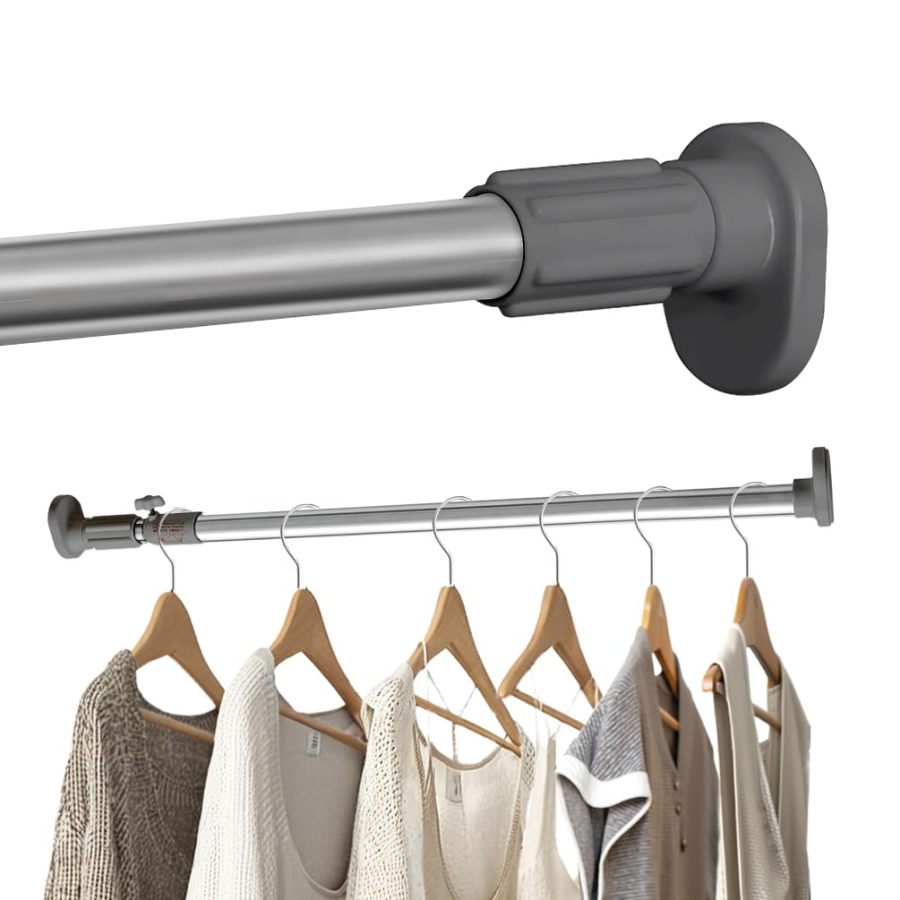
A no-drill tension rod is an adjustable rod that uses internal spring tension or a twist-lock mechanism to secure itself between two surfaces. It requires no drilling, offering a convenient temporary hanging or partitioning solution. Widely used in home spaces like windows (curtain rods), bathrooms (shower curtain rods), closets (clothing rods), doorways, and kitchens, it is favored by consumers for its easy installation and wall-friendly nature. The primary materials are stainless steel or high-carbon steel. The following table illustrates the key characteristics of consumer behavior in this category.
| Dimension | Segment | Description |
|---|---|---|
| Need Driver Type | Planned Purchase / Emergency-driven Purchase | Purchases typically stem from specific home organization, storage, or renovation plans (e.g., curtains, closets), or may arise from temporary needs like sudden privacy or space partitioning. |
| Purchase Frequency | Low Frequency | As a durable home accessory, its replacement cycle is typically long. Purchases mainly occur during moves, partial renovations, or functional adjustments, resulting in low repurchase frequency. |
| Decision Complexity | Medium | Consumers evaluate factors like length compatibility, weight capacity, installation stability, material, and price, but usually do not conduct deep research. |
| Price Sensitivity | Medium | Price is an important decision factor, but users place greater value on core benefits like actual weight capacity, installation stability, and wall safety, and are willing to pay a reasonable premium for reliable quality. |
| Emotional Dependency | Low to Medium | The primary driver is functionality and practicality, but the peace of mind from damage-free installation and the product's harmony with the home environment also contribute some emotional value. |
II. User Personas & Usage Scenarios
2.1 Renters & Temporary Improvisers
🎯 Users who value functionality and aesthetics in their living space but are constrained by rental agreements or personal preference, unwilling to make permanent alterations to walls.
| Typical Usage Scenarios | Core Pain Points | Primary Purchase Drivers |
|---|---|---|
|
|
|
2.2 Home Organization Optimizers
🎯 Household users dedicated to improving home tidiness and space utilization efficiency, adept at discovering various storage tools to optimize their living environment.
| Typical Usage Scenarios | Core Pain Points | Primary Purchase Drivers |
|---|---|---|
|
|
|
III. User Needs Hierarchy (KANO Model)
3.1 Basic Needs (Must-Haves)
- No-Drill Installation: Requires no tools, installs in seconds, does not damage walls, meeting the core user need for convenient, damage-free installation.
- Adjustable Length: Ability to extend and retract to fit spaces of different widths or heights, meeting basic adaptability, a fundamental function of tension rods.
- Basic Securing Ability: Once installed, it maintains basic stability and does not easily fall, ensuring basic safety when undisturbed.
- Rust-Resistant & Durable: The rod material should have basic rust/corrosion resistance, especially considering use in humid environments like bathrooms, ensuring a reasonable lifespan.
3.2 Performance Needs (Linear Satisfiers)
- Stable & Anti-Slip: Securely fixed on both smooth and rough surfaces, not prone to sliding or falling, capable of bearing moderate weight (e.g., a bath towel, several garments).
- Actual Weight Capacity: Ability to bear the weight of intended items (e.g., standard shower curtain, several garments) without bending, sagging, or falling, not just light loads.
- Installation Convenience & Intuitiveness: Beyond being drill-free, the operation should be intuitive and simple, allowing installation without complex steps or multiple attempts, avoiding user frustration.
- Sturdy Rod, Resistant to Bending: When extended to longer lengths or bearing moderate weight, the rod should remain straight without noticeable bending or sagging.
3.3 Excitement Needs (Delighters)
- Exceptional Weight Capacity (Heavy-Duty): Capable of bearing heavier items (e.g., heavy drapes, multiple winter garments) even at longer extensions without sagging or bending, exceeding typical no-drill rod expectations.
- Smooth Rod Joints: Multi-section or telescoping rod joints should be smooth, ensuring curtain hooks slide without obstruction or catching, enhancing user experience.
- Multi-Section/Modular & Customizable Length: Rod sections are detachable and combinable, enabling a wider, more flexible length adjustment range to cover more special-sized spaces or future needs.
- Aesthetic Design & Home Décor Integration: Offering diverse colors, finishes (e.g., matte black, brushed silver), or unique designs that coordinate with modern home styles, enhancing overall aesthetics.
3.4 Unmet Needs & Opportunities
-
Insufficient Actual Weight Capacity & Stability: Most products advertise 'heavy-duty' or 'high weight capacity,' but user feedback indicates sagging or falling during actual use (especially with heavier items, wet clothes, or over time), failing to meet advertised stability.
User Reviews (VOC) Customers have mixed experiences with the curtain rod's hold: while some report it provides good support for curtains, others mention that it keeps falling and cannot hold any weight. // Even a single shirt caused the rod to sag and eventually fall. If you're looking for a rod to hold anything heavier than baby items or sheer fabric, these are not a good choice.
-
Size Description vs. Reality Mismatch: Some products' actual usable length differs from the description (e.g., minimum length not reaching the claimed value), or lack sufficient tension at min/max lengths, making it difficult for users to precisely match their space, even creating specific size 'dead zones.'
User Reviews (VOC) Customers report that the curtain rod is too small and does not compress to the 28-inch length as advertised. // ACTUALLY USABLE @ 29"-41" NOT 28"-43". Not as pictured. // It's too slim, too short, and too flimsy for a doorway curtain. No, I didn't measure my doorways before buying, that's on me.
-
Rod Joint Catching: Joints in multi-section or telescoping rods (including adjustment pins) are not smooth enough, causing curtain hooks to catch when moving, hindering smooth curtain opening/closing.
User Reviews (VOC) Having the pin sticking through the hole in the rod gives a lump that catches the shower curtain and will not allow it to open or close. // This is pretty typical with adjustable rods, but the curtain also hangs up where the two rods join.
-
Vague or Complex Installation Instructions: Despite emphasizing 'easy installation,' some users complain about unclear instructions, poor translation, or a non-intuitive process, causing difficulty with initial setup and impacting user experience.
User Reviews (VOC) Worthless assembly instructions. // NOT SIMPLE TO INSTALL. INSTRUCTIONS NOT SO CLEAR, EVEN AFTER WATCHING THE VIDEO,
IV. User Decision Drivers
4.1 Key Decision Factors
- Installation Ease: The primary consideration for users buying no-drill tension rods, emphasizing no tools, quick installation, and no wall damage. The easier the installation, the lower the purchase barrier and user concern.
- Stability & Anti-Slip Performance: Whether the rod is secure and won't easily fall or slide after installation directly relates to safety and item integrity, a core performance metric users care about most.
- Actual Weight Capacity: Ability to bear the weight of intended items without bending, sagging, or falling, especially in specific scenarios (e.g., heavy drapes, wet clothes), is key to measuring product utility.
- Length Precision & Fit: Whether the product's size range precisely fits the required installation space (e.g., window, closet width), avoiding buying one too long or short, is crucial for reducing returns and boosting satisfaction.
4.2 Secondary Decision Factors
- Material Durability & Rust Resistance: Users care about long-term use without rust or corrosion, especially in humid environments like bathrooms; material quality directly impacts product lifespan and maintenance cost.
- Appearance Design & Color: Whether the rod's color, finish, diameter, etc., match the home décor style, enhancing overall aesthetics, is a final decision tie-breaker.
- Price Reasonableness & Value: Given core function and performance are met, whether the product price is competitive and offers good value influences the final purchase decision.
- User Reviews & Reputation: Real user experiences from other buyers, especially feedback on stability, weight capacity, and installation ease, are important references for new users' decisions.
V. Selling Points & Competitive Landscape
5.1 Selling Point Analysis
5.1.1 Standard Features (Points of Parity)
- No-Drill Installation: Most products emphasize no tools, no wall damage, easy installation, meeting user demand for convenience and damage-free setup.
- Adjustable Length: Universally highlighting the product's telescoping nature, able to adapt to different-sized spaces, a basic attribute of this product type.
- Multi-Purpose Use: Widely promoted for uses like shower curtain rods, curtain rods, closet rods, doorway dividers, emphasizing versatility.
- Anti-Slip Design: Commonly mentioning anti-slip pads or rubber end caps on both ends to increase friction with walls, aiming to enhance stability.
- Rust-Resistant, Durable Material: Claims of using stainless steel, high-carbon steel, etc., with rust-resistant treatment, suitable for humid environments and extended lifespan.
5.1.2 Key Differentiators
- Heavy-Duty Weight Capacity: Some products emphasize bearing greater weight, resisting bending/falling, quantifying this advantage with specific poundage (e.g., 22 lbs, 30 lbs, even 55 lbs).
- Rod Diameter: Offering different diameter options (e.g., 0.5 inch to 1.26 inches), implying thicker rods provide better strength and stability, attracting users with higher weight capacity demands.
- Surface Finish & Color: Mentioning diverse colors and finishes like matte black, silver, white, gray, enhancing product appearance and home décor compatibility.
- Multi-Section Modular Design: Flexible combination of multiple rod sections enables a broader length adjustment range, catering to different niche scenarios like extra-long spans or mini spaces.
5.1.3 Unique Selling Propositions (USPs)
- Dual Installation: Drill & No-Drill Options: Very few products offer both installation methods (no-drill and screw-fixed), providing extra security and peace of mind for higher weight demands while pursuing damage-free convenience.
- Specific Scenario-Optimized Design: E.g., camera-avoidance pull rod design (though not fully reflected in samples, an industry innovation point), or special anti-vibration design for RVs, meeting specific niche needs.
- Extended Warranty Promise: Some brands offer warranties as long as two years or more, building consumer trust and differentiating from products with no warranty or short-term coverage.
5.2 Competitive Landscape
5.2.1 Market Maturity
The no-drill tension rod market is highly mature, with significant homogenization in product features and selling points. Current competition mainly revolves around price wars, minor aesthetic tweaks, and verbal claims about core performance like weight capacity and anti-slip stability. Consumers generally hold a 'you get what you pay for' mindset but remain wary of exaggerated claims in the market.
5.2.2 Innovation Trends
Current innovation trends focus on improving core pain point experiences: First, enhancing actual weight capacity and long-term stability through better materials (thicker tubing), stronger spring mechanisms, and larger, higher-friction anti-slip end caps. Second, optimizing size compatibility, offering more precise size options or multi-section modular designs to eliminate size dead zones. Third, improving detail experience, e.g., smoothing rod joints to prevent curtain catching. Additionally, providing clear, easy-to-understand installation guidance and exploring differentiated colors, materials, and dual installation options to meet user demands for both aesthetics and ultimate stability.
VI. Marketing Claims vs. Reality Check
The table below analyzes the gap between common marketing claims and actual user experiences in this category:
| Dimension | Marketing Claim | User Reality | Verdict |
|---|---|---|---|
| Weight Capacity | Heavy-duty design, high-strength, can hold 22-55 lbs, easily hangs heavy clothes or curtains, stable and won't fall. | Multiple user reports indicate sagging, bending, or direct falling after hanging a few garments or a shower curtain; some products clearly state capacity of only 5 or 11 lbs, contradicting 'heavy-duty' claims, causing massive consumer expectation gaps. | This is typical marketing rhetoric challenging physics. Sellers excessively beautify product weight capacity, ignoring hard constraints like rod material, diameter, and extension length on load limits, ultimately leading to user trust collapse. |
| Size Accuracy & Compatibility | Many users complain the minimum length doesn't reach the advertised value (e.g., 28-inch product actually only shrinks to 29 inches), or there are 'dead zones' at specific length ranges (e.g., 44-49 inches) where installation is impossible. Also, some multi-section designs have complexity and error in adjustment. | Sellers are too vague in size labeling, failing to fully consider spring compression limits and tension variations at different lengths, causing products to fail at the most basic 'compatibility' level, leading to high return rates. | |
| Anti-Slip Stability | Upgraded anti-slip design, rubber ends provide super friction, firmly adheres to all walls, never falls. | Despite anti-slip claims, many users report rods easily slipping, especially in humid environments, on smooth tile, or with slightly heavier items. Some users had to add extra brackets for stability. | Sellers' anti-slip design doesn't fully account for friction coefficient differences across wall materials (smooth/rough, dry/wet), simplistically claiming 'works on all walls,' while actual performance cannot cover all scenarios, a typical conflict between physical constraints and marketing ideals. |
Key Takeaway: The no-drill tension rod market exhibits widespread parameter inflation and marketing exaggeration, particularly regarding weight capacity and size compatibility, leading to a severe mismatch between user reality and seller promises.
VII. Supply-Demand Misalignment Analysis
The table below highlights mismatches between seller focus and buyer priorities:
| Dimension | Seller Behavior | User Focus | Verdict |
|---|---|---|---|
| True Weight Capacity Performance | Widespread use of terms like 'Heavy Duty,' 'super strong weight capacity' in listings, providing high theoretical poundage as a core selling point to attract consumers. | User feedback indicates frequent falling, bending during actual use, especially with heavier garments, wet shower curtains, or over time. They need real, guaranteed weight capacity, not exaggerated claims. | Sellers pile on 'heavy-duty' labels, but product reality fails to deliver, causing post-purchase disappointment. This false selling point ultimately damages trust in the entire category. |
| Size Accuracy & Seamless Fit | Sellers generally provide a broad size adjustment range, claiming 'fits all spaces,' but lack precise measurement guidance or warnings about size 'dead zones' in product descriptions. | Users commonly complain products aren't short enough at minimum, long enough at maximum, or lack sufficient tension at certain middle lengths. They want a rod that perfectly fits their specific width, avoiding the hassle of repeated returns. | Sellers are vague on size information, failing to provide the precision users need, hindering consumers at the core decision stage (size matching), greatly reducing satisfaction. |
| Smoothness of Rod Joints | Sellers rarely mention design details of rod joints in marketing, generally viewing multi-section telescoping as an advantage for length adaptability. | Users often complain about hooks catching at rod joints or adjustment pins when installing curtains or hanging clothes, hindering smooth curtain operation and affecting daily use fluency. | Sellers treat multi-section telescoping as a pure functional advantage but overlook its negative impact on user experience (especially curtain sliding), a typical disconnect between engineering thinking and user experience. |
Key Takeaway: Sellers in the no-drill tension rod market exhibit significant supply-demand misalignment, over-promoting 'heavy-duty' and 'universal compatibility' while collectively neglecting user core needs for true weight capacity, precise size matching, and installation detail experience.
VIII. Strategic Opportunities & Recommendations
8.1 Develop Truly Heavy-Duty, Long-Term Stable No-Drill Tension Rods
8.1.1 Target Audience & Pain Points
⚡️ Pain Points Addressed: Insufficient actual weight capacity & stability, rods prone to bending/falling, poor anti-slip effect.
8.1.2 Action Plan
Use thicker-walled, high-strength stainless steel tubing (e.g., SUS304), optimize internal dual-spring or twist-lock mechanisms for strong, lasting tension. Employ large-area, high-friction silicone/rubber end caps with internal anti-slip texture. Launch multiple diameter and length combinations to precisely match different weight needs.
| Tech Complexity | Medium |
| Cost Impact | Medium Impact |
| Trade-off Warning | Increasing weight capacity may slightly increase rod diameter or weight, requiring a balance between strength and lightness. |
| Price Band | Only viable above $24.99 |
8.1.3 Marketing Strategy
Emphasize 'third-party certified weight capacity tests,' 'decades of stable support,' 'safe hanging even for wet clothes.' Build consumer trust through comparison videos showing product performance under extreme loads.
8.2 Provide Precise Size Fit & Smart Selection Solutions
8.2.1 Target Audience & Pain Points
⚡️ Pain Points Addressed: Size description vs. reality mismatch, existence of size 'dead zones,' users prone to selection errors.
8.2.2 Action Plan
Provide detailed graphic measurement guides and recommended installation length charts in listings, clearly stating optimal tension ranges for each length segment. Develop more segmented length interval products (e.g., every 5 inches) ensuring stable tension at both ends of each interval. Consider including a simple tape measure or measuring card in packaging.
| Tech Complexity | Low |
| Cost Impact | Low Impact |
| Trade-off Warning | No significant physical side effects, mainly optimizing information presentation and user guidance. |
| Price Band | Only viable above $14.99 |
8.2.3 Marketing Strategy
Focus on 'Precise Fit, End Return Hassles'; highlight '100% fits your space, zero-error installation.' Use A+ pages and videos to detail how to measure and choose size, answering user's top size concerns.
8.3 Optimize Rod Joints for Seamless Curtain Glide Experience
8.3.1 Target Audience & Pain Points
⚡️ Pain Points Addressed: Rod joints catch curtain hooks, hindering smooth operation.
8.3.2 Action Plan
Redesign telescoping joint structure, using flush-fit or seamless sleeve designs to keep rod surface absolutely smooth. Include dedicated hooks with ball bearings or low-friction material to ensure curtains glide smoothly without obstruction across the entire rod. Consider adding cushioning at joints to reduce noise.
| Tech Complexity | Medium |
| Cost Impact | Medium Impact |
| Trade-off Warning | Requires more precise molds and assembly processes, may slightly increase manufacturing cost and structural complexity, but user experience improvement is significant. |
| Price Band | Only viable above $19.99 |
8.3.3 Marketing Strategy
Emphasize 'Silky Smooth Opening & Closing, Enjoy Your Private Space'; highlight 'Goodbye to Catching, Boost Curtain Use Happiness.' Use slow-motion videos to showcase seamless hook glide along the rod.
8.4 Provide Interactive/Multimedia Installation Guidance to Improve First-Use Experience
8.4.1 Target Audience & Pain Points
⚡️ Pain Points Addressed: Vague or complex installation instructions causing user difficulty in correct setup.
8.4.2 Action Plan
Redesign concise, visual installation instructions (multi-language graphics), print QR codes on packaging linking to high-quality, step-by-step installation tutorial videos (including FAQ). Videos can show installation tips for different wall materials and weight considerations.
| Tech Complexity | Low |
| Cost Impact | Low Impact |
| Trade-off Warning | No physical side effects, mainly content creation and distribution costs. |
| Price Band | Only viable above $12.99 |
8.4.3 Marketing Strategy
Focus on 'Set Up in One Minute, Foolproof Installation'; emphasize 'Zero Frustration, Easily Enjoy No-Drill Convenience.' Use user success stories and easy setup visuals to eliminate installation anxiety.