Amazon US Market Analysis: Golf Grip Trainers Category
📊 Executive Summary
📈 Market Trends
Category is mature, price competition is intense, user pain points concentrate on fundamental experience. The golf grip trainer market suffers from severe homogenization, with most products merely listing functions. Price wars are the primary competitive tactic. Consumers increasingly value actual product stability, comfort, durability, and compatibility with different hand sizes/clubs over vague marketing terms. Left-handed user needs are chronically overlooked. New trends point towards more refined user experience optimization and differentiated services.
⚡ Major Pain Points
Slipping/falling off, poor fit, and inflated quality claims are core weaknesses. Users commonly complain about trainers slipping or detaching during use, severely disrupting training continuity. Secondly, existing product sizes often fail to fit all hand sizes (especially larger hands) and different grips, causing discomfort or unusability. Additionally, some low-priced products have inferior quality and material odor, creating a huge gap with sellers' 'high-quality, durable' claims, severely damaging consumer trust.
💡 Selection Opportunities
Return to fundamentals, deepen focus on fit and quality, expand neglected customer segments. Market opportunities lie in developing multi-size, precision-fit, highly anti-slip trainers to solve core pain points. Simultaneously, using high-quality, eco-friendly materials to enhance product durability and comfort, and providing left/right-handed versions to cover a broader user base. Furthermore, offering detailed instructional guidance lowers the learning curve for beginners. By refining details and building trust, one can stand out in the red ocean market.
I. Analysis Overview
1.1 Introduction & Report Scope
This report analyzes the 'Swing Trainers' category (golf grip trainers) within the Amazon US market, focusing on target user personas, core needs, decision factors, market communication, and potential opportunities.
1.2 Category Snapshot
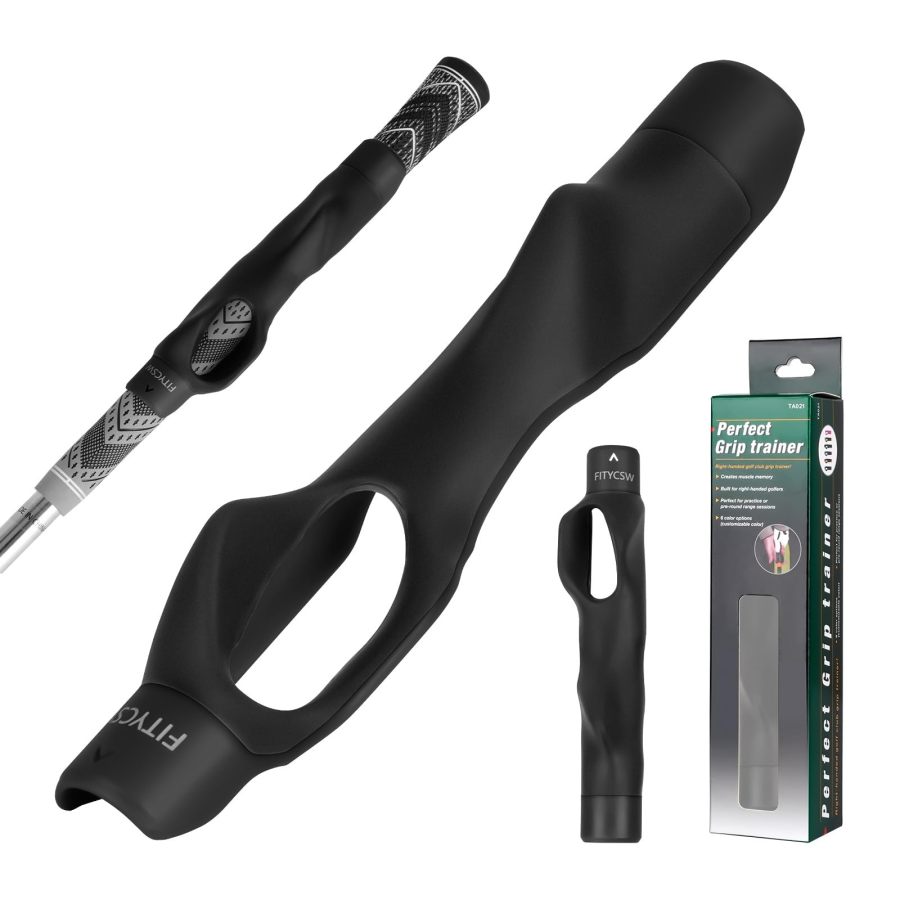
A golf grip trainer is a specialized tool designed to correct and optimize a golfer's grip posture. These products feature pre-molded hand grooves or structures to help players develop proper muscle memory for their grip, thereby enhancing swing stability, accuracy, and power. Market offerings are primarily divided into simple, quick-clip models that attach to existing club grips and permanent, replacement-type models that require installing a new grip. Materials are typically rubber or plastic, and prices are generally affordable. The following table illustrates the key characteristics of consumer behavior in this category.
| Dimension | Segment | Description |
|---|---|---|
| Need Driver Type | Planned Purchase / Impulsive Purchase | Purchases are primarily driven by a conscious plan to improve skills or impulsive attempts influenced by recommendations from friends/coaches or online content. Solving grip-related pain points is the core driver. |
| Purchase Frequency | Low Frequency | Products are typically durable; a single purchase can be used long-term. As a training aid, the repurchase cycle is long, and it is not a fast-moving consumer good. |
| Decision Complexity | Medium | Consumers compare product effectiveness, ease of use, compatibility, and price but do not engage in deep technical research, preferring quicker decisions. |
| Price Sensitivity | Medium | Price is an important consideration, especially for basic models. Users are willing to pay a reasonable premium for products that deliver significant performance improvement or effectively solve pain points. |
| Emotional Dependency | Medium | As a functional tool, it primarily fulfills the practical need to improve skills. However, the sense of achievement and confidence gained from better shots also gives the product high emotional value. |
II. User Personas & Usage Scenarios
2.1 Golf Novice / Beginner
🎯 New to golf, eager to quickly grasp basic posture to avoid developing bad habits. Focuses on ease of use and immediate feedback.
| Typical Usage Scenarios | Core Pain Points | Primary Purchase Drivers |
|---|---|---|
|
|
|
2.2 Amateur Golfer Seeking Improvement
🎯 Has some golf experience but struggles with swing inconsistency, directional errors, etc. Aims to improve performance and scores by correcting grip posture.
| Typical Usage Scenarios | Core Pain Points | Primary Purchase Drivers |
|---|---|---|
|
|
|
III. User Needs Hierarchy (KANO Model)
3.1 Basic Needs (Must-Haves)
- Accurate Hand Posture Guidance: The product must intuitively and accurately indicate and secure the correct hand placement, ensuring consistent grip posture every time. This is the core functionality.
- Easy Installation and Removal: Simple operation, allowing quick switching between clubs or easy storage, without adding complexity.
- Universal Compatibility: The product should fit most standard golf club grips, not limited to specific brands or models, reducing purchase hesitation.
3.2 Performance Needs (Linear Satisfiers)
- Slip-Resistant and Stable: During the swing, the trainer should stay firmly attached to the club without sliding or twisting, providing a stable training experience and safety.
- Comfortable Grip Feel: Skin-friendly material with a comfortable feel, preventing hand discomfort or abrasion during extended practice, increasing willingness to train.
- Good Durability: The product material should be sturdy and durable, able to withstand high-intensity, high-frequency swing impacts without easy damage, extending lifespan.
- Adapts to Different Grip Sizes: Better adaptation to various grip sizes (standard, midsize, oversized, etc.) to meet a wider range of user needs and improve universality.
3.3 Excitement Needs (Delighters)
- Left/Right-Handed Version Options: Offering versions usable by both right and left-handed players, or dedicated left-handed trainers, to meet specific group needs and enhance user experience.
- Clear Training Effect Feedback: Users can clearly perceive immediate improvements in shot distance, accuracy, or consistency, providing a sense of achievement and validating the purchase value.
- Extremely Lightweight and Portable Design: Compact size and light weight for easy portability to the driving range, course, or home, enabling training anytime, anywhere.
3.4 Unmet Needs & Opportunities
-
Poor Large Grip Compatibility: Many grip trainers are too small, struggling to fit players with larger hands or those using non-standard grips, leading to unusability or discomfort.
User Reviews (VOC) Too short for adult hands. Buy a full size Lamkin training grip. // Customers have mixed opinions about the grip trainer's size, with several noting it is too small for people with big hands and not recommended for those with large hands.
-
Prone to Slipping/Falling Off During Training: Some products fail to stay securely fixed during actual swings, easily sliding on the shaft or detaching completely, severely disrupting training continuity and safety.
User Reviews (VOC) The trainer kept moving after each swing. And did not stay tight on it after the first day. // This golf grip trainer fits loosely on my golf clubs. I had to grab on to the grip very hard to make sure my club wouldn't fly out.
-
Insufficient Product Durability: Some low-cost products use fragile materials that cannot withstand repeated high-intensity use, breaking or wearing out quickly, damaging user trust in product quality.
User Reviews (VOC) Customers report durability issues with the grip trainer, noting that it breaks easily and doesn't hold up well, with some mentioning it wears out after about 300 swings. // Made out of cheap soft plastic. It broke on the second day of using it.
-
Unnatural Feel or Foreign Object Sensation: Some snap-on designs don't integrate smoothly with the original grip, resulting in a stiff, unnatural feel, or even sharp edges that rub the hand, affecting comfort during extended training.
User Reviews (VOC) I did find it somewhat uncomfortable because it clips on to your existing grip. You feel the ridges of the device on the bottom half of the device because it's sitting on top of your grip and doesn't really smoothly transition from plastic to grip.
-
Lack of Clear Usage Instructions: Some products lack instructions in the packaging, leaving users unsure how to correctly install, adjust, or maximize results with the trainer, increasing the learning curve.
User Reviews (VOC) It's a little confusing how to line it up because there is no documentation or instructions included. // No instructions at all.
-
Product Material Odor: Some new products have a noticeable plastic or rubber odor, negatively impacting the unboxing experience and willingness to use, raising safety concerns.
User Reviews (VOC) When I received the goods and opened them, I smelled a very pungent smell. It's too unpleasant
-
Insufficient Left/Right-Handed Compatibility: Most products are designed only for right-handed golfers, with scarce or no options for left-handed users, limiting market coverage.
User Reviews (VOC) Right-Handed, Snap-On Design & Universal Fit: Our grip fix golf trainer is engineered specifically for right-handed golfers. // Product is suitable for right-handed golfers only.
IV. User Decision Drivers
4.1 Key Decision Factors
- Accuracy of Hand Posture Guidance: Whether it can effectively and clearly guide the hands to the correct grip position is the primary purchase consideration, directly impacting training results.
- Ease of Use and Installation Convenience: Whether installation is simple and quick, allowing for immediate use, directly influences purchase decisions and usage frequency, especially for beginners.
- Compatibility with Existing Clubs: Whether the product fits the user's various club grips is key to ensuring normal use and avoiding returns due to size incompatibility.
4.2 Secondary Decision Factors
- Stability During Training: Whether the trainer stays firmly in place during the swing without interfering with the motion relates to training effectiveness and safety, affecting user trust.
- Material and Grip Comfort: The feel of the material, its slip resistance, and comfort during prolonged gripping are important metrics for users evaluating experience and value.
- Product Durability: Whether the product is sturdy and can withstand long-term training wear and impact is a consideration for value-for-money and long-term investment.
- Price Reasonableness: Given that core functionality and quality requirements are met, whether the price is competitive influences purchase intent.
- Portability: Whether the product is lightweight and easy to carry to the driving range, course, or use at home anytime, enhancing training flexibility.
V. Selling Points & Competitive Landscape
5.1 Selling Point Analysis
5.1.1 Standard Features (Points of Parity)
- Corrects Hand Posture/Muscle Memory: Almost all products emphasize guiding users to a correct grip through their design to form muscle memory. This is the core selling point and user expectation for the category.
- Improves Swing Consistency/Accuracy: By improving grip posture, it ultimately enhances shot stability and precision. This is the user's end goal and a commonly claimed benefit.
- Easy to Install/Use: Most products advertise their snap-on or simple design for quick installation and ease of use, lowering the barrier to entry.
- Suitable for All Skill Levels: Emphasizing benefits for both beginners and experienced players broadens the target audience and attracts a wider consumer base.
- Durable, Slip-Resistant Material: Most products claim to use high-quality, slip-resistant, and durable materials to ensure longevity and training stability, meeting basic quality expectations.
5.1.2 Key Differentiators
- Left/Right-Handed Version Options or Universal Fit: Some products explicitly offer universal fit or distinct left/right-handed versions to meet specific player needs, expanding market coverage.
- Multi-Size Compatibility: A few products claim to adapt to different grip sizes (e.g., standard, midsize, oversized), attempting to address the common size mismatch issue.
- Lightweight and Portable Design: Highlighting the product's compactness and lightness for easy carrying, enabling training anytime, anywhere, emphasizing convenience.
- Fast Results/Immediate Feedback: Emphasizing the product's ability to deliver quick, noticeable results, helping users rapidly correct bad habits and boosting purchase confidence.
- Addresses Specific Swing Issues: Some products focus more on solving specific pain points like hooks, slices, or lack of power, offering more targeted solutions.
5.1.3 Unique Selling Propositions (USPs)
- PGA Coach Recommended: A few brands cite endorsement from PGA coaches to enhance product professionalism and credibility, creating brand endorsement.
- Integrated Weight-Adjustable Swing Trainer: e.g., SKLZ B0019GKDTM, which not only corrects grip but also features weight adjustment, serving as a swing tempo and strength trainer, offering richer, multi-dimensional training functionality.
- Solid' Design Advantage: Some products (e.g., WENTCCION) claim their 'solid' structure offers advantages over traditional 'concave' designs, providing more consistent feedback and durability, emphasizing structural innovation.
- BPA-Free/Latex-Free Material: Very few products emphasize health-conscious and eco-friendly material properties, attracting detail-oriented and health-conscious consumers, building differentiated value.
- Hook-and-Loop Fastening Structure: Goose Golf B0F9LBMGBD uses hook-and-loop fasteners for auxiliary fixation, claiming stronger attachment to the grip to reduce slippage and enhance stability.
5.2 Competitive Landscape
5.2.1 Market Maturity
The golf grip trainer market is quite mature, with product forms and core functions highly homogenized. Most products are simple snap-on or replacement plastic/rubber grips, with core selling points concentrated on 'correcting grip,' 'improving swing,' and 'ease of use.' Differentiation between brands mainly lies in material details, marketing angles, and price positioning, but overall innovation is low. Competition revolves around cost-performance ratio and user experience details, indicating the market is in a red ocean stage.
5.2.2 Innovation Trends
Current innovation trends primarily focus on optimizing existing pain points: First, moving towards stronger 'compatibility' and 'stability' to address issues of slippage and poor fit. Second, improving 'comfort' and 'natural feel' to reduce discomfort during training. Third, some products are beginning to focus on added values like 'material health and eco-friendliness' to meet growing consumer quality demands. Finally, emphasizing the combination of 'quick results' and 'long-term muscle memory development' to make training effects more perceptible and extend user engagement cycles.
VI. Marketing Claims vs. Reality Check
The table below analyzes the gap between common marketing claims and actual user experiences in this category:
| Dimension | Marketing Claim | User Reality | Verdict |
|---|---|---|---|
| Size Compatibility | 'One-size-fits-all,' suitable for all hand sizes and club grips, highly universal. | Multiple user reviews indicate products are often too small for adult-sized hands or cannot fit snugly on oversized grips, causing discomfort or inability to secure. Some products even require removing the original grip for installation, contradicting 'universal' claims. | Claiming 'one-size-fits-all' with a single mold size contradicts ergonomic and physical fitting principles, ignoring actual variations in hand size and grip dimensions. This overpromise leads to widespread user issues with poor fit and discomfort. |
| Product Stability | 'Powerful anti-slip, secure and won't fall off,' ensuring uninterrupted training. | Numerous user reviews report the product easily slides, twists, or even detaches from the club during use, requiring frequent readjustment, severely disrupting training. This starkly contrasts with advertised 'anti-slip and secure' claims. | A significant gap exists between the seller's claimed 'anti-slip' feature and the product's actual ability to stay fixed under the dynamic forces of a golf swing, indicating that the clip design or material friction coefficient fails to meet the demands of the swing motion. This represents a core functional failure. |
| Material and Durability | 'High-quality, sturdy and durable, long-lasting.' | Many users complain about cheap-feeling materials, a strong plastic look, and products wearing out, cracking, or breaking after just a few uses. Some products also have a pungent odor. | Low-priced products forcibly use marketing terms like 'high-quality, durable' that are disconnected from their actual material costs and production processes. Consumers paying a low price often receive low quality. This false advertising severely erodes trust in the category. |
Key Takeaway: The golf grip trainer market is rife with widespread marketing exaggeration and inflated claims, especially regarding compatibility, durability, and feel. Consumer trust in advertised claims is low.
VII. Supply-Demand Misalignment Analysis
The table below highlights mismatches between seller focus and buyer priorities:
| Dimension | Seller Behavior | User Focus | Verdict |
|---|---|---|---|
| Stability During Training | Sellers generally emphasize products are 'anti-slip and durable' but rarely provide specific technical details (e.g., anti-slip structural design, test data) in listings to support their promise of 'no slipping' during actual swings. | Users are most concerned about whether the trainer stays firmly in place during the swing without affecting their motion. However, widespread feedback indicates products easily slip or fall off, requiring frequent adjustment, which severely disrupts training continuity. | Sellers fail to directly confront and solve the user's core 'training stability' pain point, causing products to underperform in the most critical experience aspect, directly leading to high return rates. |
| Left/Right-Handed Version Coverage | Most products are explicitly or implicitly designed only for right-handed players. A few brands claim to have left/right-handed versions but then limit options or emphasize right-hand use in detail pages, causing information confusion. | Left-handed golfers, as a specific user group, find very few options when purchasing. Some even encounter products advertised as universal but actually limited to right-hand use, feeling neglected. | Sellers generally overlook the left-handed golfer segment, failing to provide sufficient and clear left/right-handed compatibility solutions, leading to lost market share. |
| Feel and Ergonomic Comfort | Sellers commonly advertise 'ergonomic design,' 'comfortable grip feel,' but often stop at superficial vocabulary without in-depth detail description or technical support. | Users report that some snap-on trainers don't integrate smoothly with the original grip, resulting in a stiff, unnatural feel, a foreign object sensation, or even hand abrasion during prolonged use, creating a stark contrast with marketing claims. | Sellers over-promise on comfort, but product design fails to adequately consider the natural curve of the hand and smooth transition to the grip, leading to a significant disconnect between actual user experience and expectations. This represents ineffective competition within the same narrow focus. |
Key Takeaway: Sellers commonly indulge in vague self-praise about 'universality' and 'ease of use' while collectively ignoring user pain points like 'actual stability,' 'comfort,' and 'left/right-handed compatibility.' There is a severe misalignment between supply and demand focus.
VIII. Strategic Opportunities & Recommendations
8.1 Multi-Size, Precision-Fit Anti-Slip Grip Trainer
8.1.1 Target Audience & Pain Points
⚡️ Pain Points Addressed: Poor large grip compatibility; prone to slipping/falling off during training; limited hand size adaptation.
8.1.2 Action Plan
Develop at least M/L/XL sizes, or design an adjustable clip to ensure compatibility from standard to Jumbo+ grips. Incorporate a high-friction coefficient silicone liner or fine anti-slip texture to enhance grip attachment. Optimize clip edges for a smooth transition with the grip, improving feel.
| Tech Complexity | Medium |
| Cost Impact | Medium Impact |
| Trade-off Warning | Providing multiple sizes or an adjustable structure may slightly increase mold costs and material complexity but offers significant user experience improvement. |
| Price Band | Only viable above $19.99 |
8.1.3 Marketing Strategy
Emphasize 'Custom-level fit, say goodbye to slipping woes.' Provide detailed size measurement guides and demo videos showcasing perfect fit and stability on various grips. Highlight 'Every swing is precise and stable, making training more efficient.'
8.2 High-Quality, Eco-Friendly, Durable Training Grip
8.2.1 Target Audience & Pain Points
⚡️ Pain Points Addressed: Insufficient product durability; product material odor; perceived mediocre value.
8.2.2 Action Plan
Select medical-grade or food-grade, odor-free, eco-friendly TPR/PC composite materials. Obtain chemical substance testing reports from third-party authoritative agencies (e.g., SGS) to ensure non-toxicity and odorlessness. Reinforce product structural design, increase wall thickness, or optimize stress points to withstand 5000+ high-intensity swing impacts without wear or cracking.
| Tech Complexity | Low |
| Cost Impact | Medium Impact |
| Trade-off Warning | Using higher-quality materials increases unit cost but has no significant physical side effects. |
| Price Band | Only viable above $14.99 |
8.2.3 Marketing Strategy
Highlight 'Eco-friendly and odorless, train with peace of mind'; emphasize 'Built to last, one investment for long-term benefit.' Provide SGS eco-certification reports and use extreme durability test videos (e.g., continuous high-intensity striking) as selling points to dispel user doubts about quality and durability.
8.3 Universal or Separate Custom Left/Right-Handed Trainer
8.3.1 Target Audience & Pain Points
⚡️ Pain Points Addressed: Insufficient left/right-handed compatibility; right-hand only.
8.3.2 Action Plan
Prioritize developing a truly universal design (e.g., symmetrical mold) or directly launch a dedicated left-handed version to avoid ambiguous claims. Clearly label hand orientation in listings and provide comparison images of right and left-handed usage.
| Tech Complexity | Low |
| Cost Impact | Low Impact |
| Trade-off Warning | Developing left/right-handed versions increases SKU count but has no significant physical side effects. A universal design requires cleverer engineering to accommodate both hand orientations. |
| Price Band | Only viable above $9.99 |
8.3.3 Marketing Strategy
Emphasize 'Progress for everyone, worry-free training for all golfers.' Highlight 'Breaking barriers, giving left-handed golf enthusiasts access to professional training tools.' Utilize user testimonials showcasing real cases where both right and left-handed users benefit.
8.4 Grip Trainer with Detailed Instructional Guidance
8.4.1 Target Audience & Pain Points
⚡️ Pain Points Addressed: Lack of clear usage instructions; high initial difficulty; insufficient guidance information.
8.4.2 Action Plan
Include detailed picture/instruction manuals in packaging, covering correct grip breakdowns, installation steps, FAQs, and training suggestions. Use QR codes to direct users to comprehensive online tutorial videos (e.g., demonstrations of different grips, common error corrections).
| Tech Complexity | Low |
| Cost Impact | Low Impact |
| Trade-off Warning | Adding manuals or video content costs very little, with no physical side effects. |
| Price Band | Only viable above $7.99 |
8.4.3 Marketing Strategy
Emphasize 'Beginner-friendly, learn instantly.' Highlight 'Professional instruction, systematic improvement.' Position 'free instructional resources' as added value, differentiating from competitors lacking guidance, lowering the user learning barrier, and enhancing purchase confidence.