Amazon US Market Analysis: Portable Folding Umbrellas Category
📊 Executive Summary
📈 Market Trends
Emphasis on both portability and multi-functionality, with rising demand for personalization and safety. The portable folding umbrella market is maturing. Beyond basic functions, consumers increasingly expect products that balance rain and sun protection, lightness, durability, and ease of operation. Differentiating features like reverse folding, special handles, UV protection, and safety reflectivity are gaining attention.
⚡ Major Pain Points
Exaggerated wind resistance claims and poor shaft retraction are core pain points. Sellers commonly over-promise wind resistance, creating a significant gap with user experience. While automatic umbrellas open automatically, retracting the shaft is effortful and prone to jamming, failing to deliver truly smooth one-handed operation. Additionally, the physical contradiction between lightweight design and large canopy size, along with durability issues over long-term use, urgently need resolution.
💡 Selection Opportunities
Deepen focus on user experience, deliver on functional promises, and build brand trust. Market opportunities lie in developing 'Breakthrough Effortless Automatic Shaft Retraction Technology' to solve the retraction pain point; providing a 'Verifiable Extreme Wind-Resistant & Durable Folding Umbrella' to rebuild trust with data and facts. Simultaneously, address the wet umbrella issue with an 'Inside-Out Dry Reverse Folding Quick-Dry Umbrella' and explore innovation for a 'Folding Umbrella Balancing Lightweight & Large Canopy' to achieve differentiation and enhance brand premium in higher price tiers.
I. Analysis Overview
1.1 Introduction & Report Scope
This report analyzes the 'Folding Umbrellas' category (portable folding umbrellas) within the US Amazon marketplace, focusing on target user personas, core needs, decision drivers, market communication, and potential opportunities.
1.2 Category Snapshot
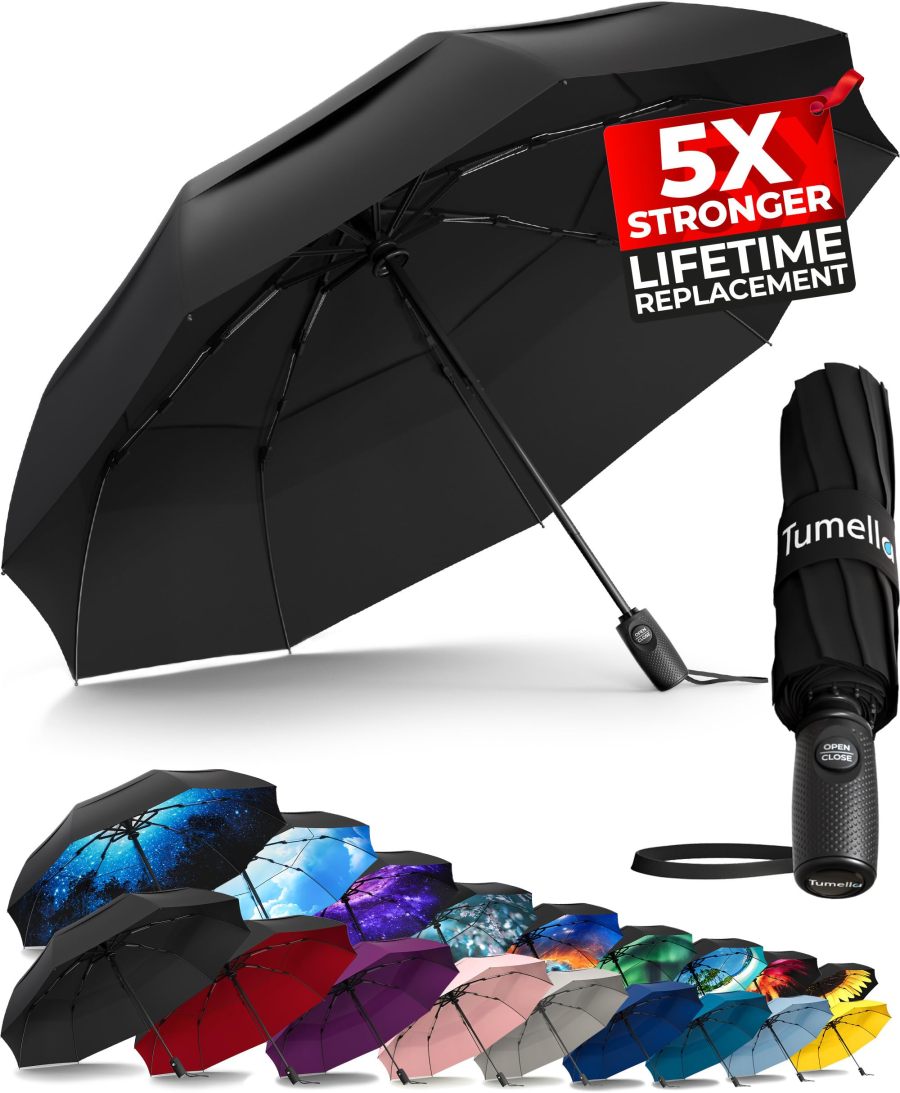
Portable folding umbrellas are rain gear characterized by their lightness, compactness, and ease of storage, designed to provide convenient protection against rain or sun. Their primary functions include rain protection, sun shading, and wind resistance. Common sub-types include one-button automatic open/close umbrellas, mini pocket umbrellas, designs emphasizing multi-rib wind-resistant structures, and umbrellas with UV protection for dual sun and rain use. Some products also incorporate innovative features like reverse folding, special handles, or reflective strips to enhance user experience and safety. The following table illustrates the key characteristics of consumer behavior in this category.
| Dimension | Segment | Description |
|---|---|---|
| Need Driver Type | Emergency-driven / Planned Purchase | Primarily purchased to deal with sudden weather changes or as a preparatory essential for daily commutes, travel, or outdoor activities. |
| Purchase Frequency | Low / Medium Frequency | Typically purchased every few years, but frequency may increase due to loss or damage, and is influenced by seasonal rainfall or travel plans. |
| Decision Complexity | Medium | Consumers compare factors such as portability, wind resistance, ease of opening/closing, sun protection effectiveness, and brand reputation. |
| Price Sensitivity | Medium | Price is an important consideration, but users are willing to pay more for more reliable wind resistance, durability, and convenient features. |
| Emotional Dependency | Low to Medium | The primary driver is functional utility, but product design, brand promise, and a sense of security during use can enhance emotional value. |
II. User Personas & Usage Scenarios
2.1 Urban Commuter
🎯 Lives a fast-paced life, values efficiency and convenience, and desires lightweight, portable rain gear that can quickly adapt to weather changes during commutes.
| Typical Usage Scenarios | Core Pain Points | Primary Purchase Drivers |
|---|---|---|
|
|
|
2.2 Outdoor Traveler
🎯 Frequently travels or engages in outdoor activities, demanding higher standards for weather resistance, versatility, and ultimate portability from an umbrella.
| Typical Usage Scenarios | Core Pain Points | Primary Purchase Drivers |
|---|---|---|
|
|
|
III. User Needs Hierarchy (KANO Model)
3.1 Basic Needs (Must-Haves)
- Rain Protection: The core function of an umbrella; it must effectively block rain and keep the user dry.
- Portable Folding: As a folding umbrella, it must fold easily into a compact size for convenient carrying and storage.
- Comfortable Handle Grip: The handle design should be ergonomic, providing a secure and comfortable grip that doesn't slip easily.
3.2 Performance Needs (Linear Satisfiers)
- Automatic Open/Close: One-button automatic opening and closing of the canopy, significantly enhancing convenience, especially when entering/exiting places or when hands are full.
- Wind Resistance & Stability: The umbrella should have sufficient structural strength and flexibility to avoid flipping or damage in stronger winds.
- Waterproof & Quick-Drying: Canopy material should have efficient water-repellent properties, allowing water to bead and roll off quickly, and dry within a short time.
- Sufficient Coverage Size: When open, the canopy should be large enough to provide ample coverage for one person or accommodate two.
3.3 Excitement Needs (Delighters)
- UV Sun Protection: Provides high UPF sun protection, allowing the umbrella to serve as an effective sunshade on clear days, enabling dual rain/sun use.
- Reverse Folding Design: When closed, the wet side faces inward, effectively preventing water from dripping on clothes, floors, or car interiors, enhancing user experience.
- Ultra-Lightweight: Achieves extreme lightness while ensuring sturdiness and durability, making it almost unnoticeable to carry.
- Unique & Personalized Appearance: Novel colors, patterns, or unique handle designs that satisfy consumers' desire for self-expression and fashion sense.
3.4 Unmet Needs & Opportunities
- Truly Effortless Shaft Retraction: Many automatic umbrellas can close the canopy automatically, but retracting the shaft still requires significant user effort to press down, failing to achieve completely easy one-handed operation.
- All-Weather Extreme Wind Resistance: Despite claims of wind resistance, most products still struggle to withstand truly strong winds (e.g., hurricane-level), and users expect a higher standard of windproof performance.
- Better Balance Between Lightweight & Large Size Design: Users want an umbrella that is both large enough (to cover two people) and remains lightweight and compact when folded, a balance often difficult to achieve perfectly in current market products.
- Long-Lasting Durability & Corrosion Resistance: Some users report issues like loose, wobbly, or rusted ribs or center poles after some use, affecting lifespan and experience.
- Handle Grip Compatibility: Some handle designs may not be friendly to different hand sizes or prolonged holding, or the material may become slippery or sticky, affecting comfort.
IV. User Decision Drivers
4.1 Key Decision Factors
- Effective Rain & Sun Protection: The most core practical function of an umbrella; users prioritize ensuring effective protection from harsh weather, staying dry and un-sunburned.
- Wind Resistance Performance: Directly impacts user experience and product lifespan; users are highly concerned about the umbrella's stability in windy conditions, not wanting it to flip or break.
- Portability & Storage: The folded size, weight, and ease of fitting into everyday bags or cars are key considerations in the purchase decision.
- Product Durability: Users expect the purchased umbrella to be long-lasting, with reliable quality in ribs, canopy, and opening/closing mechanisms, not prone to failure.
4.2 Secondary Decision Factors
- Ease of Opening/Closing: The smoothness of the automatic open/close function, especially whether retracting the shaft is easy and effortless, impacts daily use experience.
- Appearance Design & Color: The product's color, patterns, overall design style, and innovative features like reverse folding, satisfying personalization and aesthetic needs.
- Dryness When Closed: How well water droplets are controlled after closing, avoiding wetting the surroundings, and whether a protective sleeve is provided for convenient storage.
- Brand Reputation & Warranty: After-sales service promises (e.g., lifetime warranty) and market reviews provided by the brand can effectively boost purchase confidence.
V. Selling Points & Competitive Landscape
5.1 Selling Point Analysis
5.1.1 Standard Features (Points of Parity)
- Compact & Small: Emphasizes the mini size when folded, easy to fit into backpacks, handbags, or cars, enhancing daily carrying convenience.
- Automatic Open/Close: Commonly claims one-button automatic opening and closing for quick response to weather changes.
- Strong Wind Resistance: Most products highlight the use of multiple ribs (e.g., 8/10 ribs), fiberglass, or alloy rib materials to enhance wind resistance.
- Waterproof & Quick-Dry: Widely uses high-density water-repellent fabrics (e.g., Teflon coating or 210T pongee) to ensure the canopy dries quickly.
- Dual Sun & Rain Use: Most products claim UV protection (UPF50+), usable for both rain and sun protection.
5.1.2 Key Differentiators
- Reverse Folding Design: The wet side faces inward when closed, preventing water spillage, effectively solving the wet umbrella issue, and enhancing user experience.
- Unique Handle Design: Such as carabiner handles or ergonomic rubber grips, improving grip comfort or adding hanging functionality.
- Higher-Level Wind Tunnel Testing: Some brands claim passing 70MPH or even 85MPH wind tunnel tests, using specific data to strengthen the credibility of wind resistance performance.
- Multiple Color/Pattern Options: Offering various colors or interior print patterns to meet consumer demand for personalization and aesthetics.
5.1.3 Unique Selling Propositions (USPs)
- 360° Reflective Strip: Adding reflective material to the canopy edge or handle to increase visibility and safety in low-light or nighttime conditions.
- Lifetime Warranty Promise: Very few top brands offer unconditional lifetime warranty or replacement service, significantly enhancing consumer trust and purchase intent.
- Brand Story & Design Philosophy: A few products emphasize design origins from specific regions (e.g., Austin, USA; Netherlands), giving the product a unique cultural or functional background.
5.2 Competitive Landscape
5.2.1 Market Maturity
The portable folding umbrella market has entered a mature stage with a high degree of product homogenization. Core functions like automatic open/close, basic wind resistance, and waterproofing have become standard. Competition among brands primarily revolves around seeking differentiation through material upgrades, innovative detail features (e.g., reverse folding, UV protection effectiveness), design aesthetics, and after-sales service (e.g., warranty policies).
5.2.2 Innovation Trends
Innovation trends manifest in several areas: First, functional integration and extreme optimization, such as deeply integrating efficient UV protection with strong wind resistance while pursuing a balance between lightweight and large size. Second, enhancement of user experience details, like reverse folding to solve wet umbrella issues, carabiner handles for added portability, and smoother, more effortless automatic shaft retraction mechanisms. Third, safety and personalization needs, such as adding reflective strips for nighttime visibility and offering more personalized patterns. Additionally, some brands attempt to build competitive barriers on a trust level by emphasizing manufacturer background and worry-free warranties.
VI. Marketing Claims vs. Reality Check
The table below analyzes the gap between common marketing claims and actual user experiences in this category:
| Dimension | Marketing Claim | User Reality | Verdict |
|---|---|---|---|
| Wind Resistance Performance | Claims of withstanding hurricane-level winds (e.g., 70MPH, 85MPH), using multiple ribs (8/10 fiberglass ribs). | Users commonly report the canopy flipping or ribs breaking easily in moderate-to-strong winds, showing a significant gap from the advertised extreme wind resistance. | This is typical parameter inflation and scenario exaggeration. Sellers use ideal lab data or specific rib counts as selling points but fail to deliver the claimed protection in real wind conditions through synergistic structural design and materials. |
| Automatic Open/Close Operation | Emphasizes 'one-button automatic open/close,' 'easy one-handed operation,' for convenient, quick deployment and storage. | Users report smooth automatic opening but note that retracting the shaft requires significant force to press down, sometimes even jamming, failing to provide a truly 'one-click full retraction' convenient experience. | Sellers blur the technical difference between 'automatic opening' and 'automatic shaft retraction' in marketing, creating a conflict between consumer expectations for 'fully automatic one-button' operation and the reality of 'semi-automatic' function, impairing the core user experience. |
| Lightweight Claims vs. Actual Weight | Claims of 'ultra-lightweight,' 'less than 1 pound,' while also emphasizing 'strong wind resistance' or 'large canopy.' | The actual weight of some products (e.g., Repel claims <1lb, actual measurement 1.85 lbs) severely contradicts the claim; achieving extreme lightness while ensuring sturdiness and a large canopy is inherently difficult, leading to user perception of heaviness and bulkiness. | A classic physical paradox and pure exaggeration. There are inherent trade-offs between lightness, sturdiness, and large canopy size. Sellers attempt to circumvent this contradiction, resulting in false information and user experience gaps. |
Key Takeaway: The portable folding umbrella market is rife with overpromising on product performance, especially regarding wind resistance strength and the convenience of automatic operation, leading to a severe disconnect between consumer expectations and actual experience.
VII. Supply-Demand Misalignment Analysis
The table below highlights mismatches between seller focus and buyer priorities:
| Dimension | Seller Behavior | User Focus | Verdict |
|---|---|---|---|
| Experience of Automatic Shaft Retraction | Sellers commonly emphasize 'one-button automatic open/close,' but their marketing focus stays on 'automatic opening,' rarely mentioning or demonstrating the smoothness and effortlessness of the 'retraction' phase. | Users frequently complain about difficulty fully pressing the shaft back when closing the umbrella, requiring strenuous effort, especially when in a hurry or with less strength, expecting a truly fully automatic experience. | Sellers focus marketing only on the initial 'wow factor' of opening, neglecting the 'pain point' in the latter half of the user journey, causing a break in the core promise of convenience. |
| Long-Term Reliability of Product Structure & Materials | Sellers commonly emphasize 'sturdy and durable,' 'reinforced with multiple ribs,' but typically lack clear communication about durability details like corrosion resistance, prevention of looseness, or wobbling in ribs and center poles over long-term use. | Users report issues like easily damaged ribs, wobbly center poles, or even rust, casting doubt on the product's long-term reliability and desiring a high-quality product that lasts for years. | Sellers focus on creating an initial impression of 'sturdiness' for the first purchase but fail to address users' deeper concerns about the umbrella's quality throughout its lifecycle, leading to a trust crisis. |
| Authenticity & Credibility of Wind Resistance Performance | Sellers commonly use exaggerated 'hurricane-proof' claims or high wind speed data as core selling points but lack intuitive, credible real-world scenario test verification. | Users are skeptical of wind resistance claims during actual use, believing most products still fail in strong winds, and expect more truthful performance promises. | Sellers are collectively caught in a self-congratulatory 'wind resistance parameter race,' failing to provide the promise users truly care about: 'not flipping in real-world conditions.' The severe information asymmetry damages brand credibility. |
Key Takeaway: Sellers collectively over-market 'wind resistance capability' while neglecting the collective user demand for 'effortless shaft retraction' and 'product longevity' among other detailed pain points, leading to a misalignment of supply and demand focus.
VIII. Strategic Opportunities & Recommendations
8.1 Breakthrough Effortless Automatic Shaft Retraction Technology
8.1.1 Target Audience & Pain Points
⚡️ Pain Points Addressed: Effortful retraction of automatic umbrella shafts; poor operation of automatic open/close function.
8.1.2 Action Plan
Redesign the shaft telescoping mechanism, introducing a more efficient pneumatic or spring-assisted system to ensure the shaft retracts smoothly and effortlessly to its full position after one-button automatic closing. Optimize the handle button's force feedback for better operational comfort.
| Tech Complexity | Medium |
| Cost Impact | Medium Impact |
| Trade-off Warning | May slightly increase the complexity and weight of the internal shaft mechanism, but users are willing to accept this for ultimate convenience. |
| Price Band | Only viable above $19.99 |
8.1.3 Marketing Strategy
Emphasize 'Say goodbye to effort, truly one-click full retraction'; Use comparison videos to show the force difference between old and new models during retraction; Target commuting scenarios, highlighting the advantage of 'instant close and go' when entering/exiting cars or subways.
8.2 Verifiable Extreme Wind-Resistant & Durable Folding Umbrella
8.2.1 Target Audience & Pain Points
⚡️ Pain Points Addressed: Insufficient actual wind resistance; fluctuating product durability; concerns about long-term use endurance.
8.2.2 Action Plan
Use aerospace-grade aluminum alloy, high-strength carbon fiber, or flexible fiberglass composite materials for ribs and center pole, combined with innovative wind-resistant structural designs (e.g., double-layer ventilation, multi-point support). Obtain third-party authoritative lab wind resistance certification reports and publish actual test videos.
| Tech Complexity | High |
| Cost Impact | High Impact |
| Trade-off Warning | Achieving extreme wind resistance may require thicker composite materials or more complex structures for ribs, potentially slightly increasing folded volume and weight, requiring a balance with portability. |
| Price Band | Only viable above $29.99 |
8.2.3 Marketing Strategy
Highlight 'Scientifically certified, fearless in the face of storms'; Emphasize 'Built for extreme weather, ensuring outdoor safety'; Combine with brand story to showcase investment in materials science and engineering design, conveying professionalism and trustworthiness.
8.3 Inside-Out Dry Reverse Folding Quick-Dry Umbrella
8.3.1 Target Audience & Pain Points
⚡️ Pain Points Addressed: Messy storage (water droplets wetting clothes/bag contents); poor dryness when closed.
8.3.2 Action Plan
Adopt a mature reverse folding structure combined with the latest generation of super-hydrophobic nano-coating fabric to ensure rainwater beads and rolls off quickly, keeping the inside dry. Consider including a storage sleeve made of water-absorbent material.
| Tech Complexity | Low |
| Cost Impact | Low Impact |
| Trade-off Warning | The reverse folding structure may make the umbrella head slightly bulkier, but the significant improvement in user experience makes this acceptable. |
| Price Band | Only viable above $16.99 |
8.3.3 Marketing Strategy
Emphasize 'Close it dry-dry hands, dry car, dry bag'; Use videos to demonstrate the lotus leaf effect of water on the fabric and the dry state after closing; Highlight its ideal suitability as a car or office staple.
8.4 Folding Umbrella Balancing Lightweight & Large Canopy
8.4.1 Target Audience & Pain Points
⚡️ Pain Points Addressed: Difficulty achieving both lightweight and large size; small canopy coverage area; relatively high product weight.
8.4.2 Action Plan
Use multi-section ultra-thin high-strength aluminum alloy or carbon fiber shafts, combined with high tensile strength, low gram-weight canopy fabric. Re-optimize structural design to maximize canopy size while controlling weight, e.g., achieving a 54-inch canopy that folds down to under 1 pound.
| Tech Complexity | High |
| Cost Impact | High Impact |
| Trade-off Warning | Requires balancing material strength, lightweight design, and manufacturing cost; trade-offs still exist but can be optimized from the current baseline. |
| Price Band | Only viable above $34.99 |
8.4.3 Marketing Strategy
Highlight 'Big on coverage, light on the go'; Emphasize 'Share with two, without sacrificing portability'; Leverage precision manufacturing and material advantages to establish a premium folding umbrella image, meeting user expectations for 'having your cake and eating it too.'