Amazon US Market Analysis: Wireless Lavalier Microphones Category
📊 Executive Summary
📈 Market Trends
Portable wireless solutions are mainstream; trickle-down of professional features is the trend. The wireless lavalier microphone category on Amazon US is highly competitive, with strong user demand for compact size, plug-and-play operation, and basic noise reduction. Simultaneously, the market is moving towards more professional audio processing (e.g., AI noise reduction, high bitrate recording), longer battery life, and more convenient multi-device compatibility, indicating mid-range products will integrate more high-end features.
⚡ Major Pain Points
Exaggerated battery life and insufficient environmental noise reduction are critical flaws. Users are generally dissatisfied with the significant gap between advertised battery life and real-world experience. Secondly, existing noise reduction struggles to meet the demand for pure voice in complex environments like windy outdoors or noisy crowds. Poor accessory durability (e.g., clips) and cumbersome multi-device switching are also frequent complaints.
💡 Selection Opportunities
Focus on real pain points, enhance key experiences. Core opportunities lie in developing a truly 'plug-and-play' multi-interface smart receiver to solve compatibility and switching efficiency. Secondly, invest in R&D for 'scenario-adaptive smart noise reduction' to deliver pure sound in complex environments. Additionally, popularizing 'built-in storage backup' and optimizing 'accessory durability' can significantly improve product reliability and user satisfaction, building differentiation advantages.
I. Analysis Overview
1.1 Introduction & Report Scope
This report analyzes the 'Wireless Lavalier Microphones' category within the Amazon US market, focusing on target user personas, core needs, decision factors, market communication, and potential opportunities.
1.2 Category Snapshot
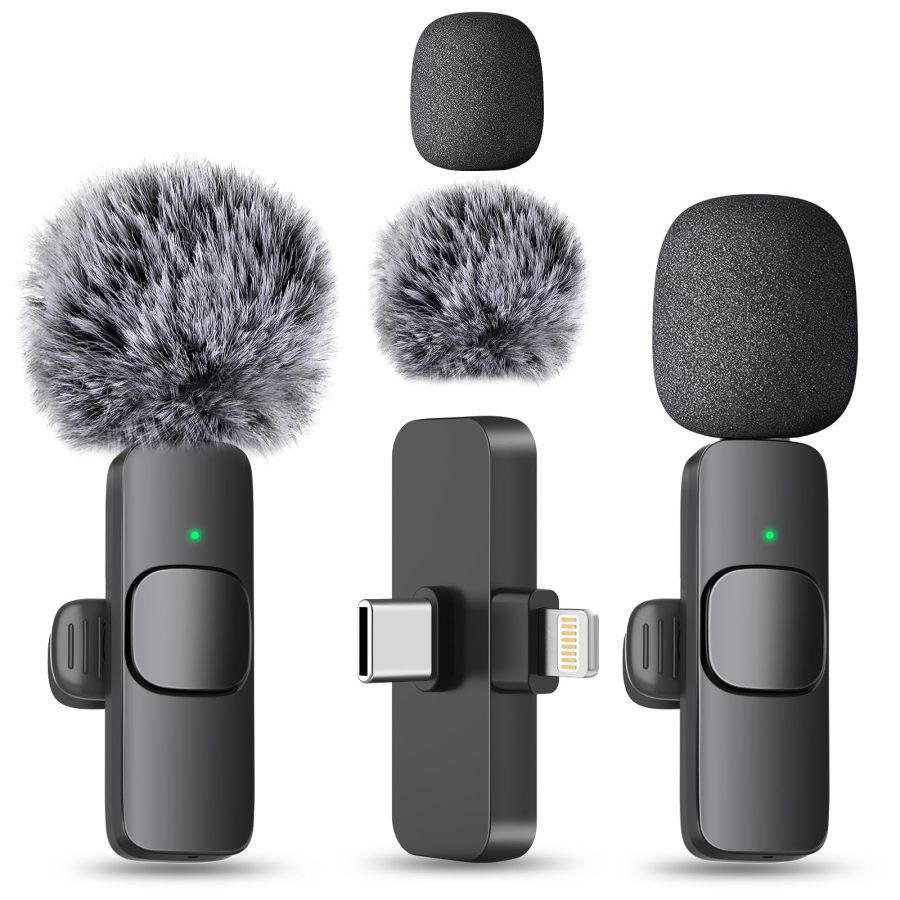
A wireless lavalier microphone (also known as a wireless mic or 'little bee') is a compact, portable, hands-free audio recording solution primarily used to capture voice via wireless transmission. It is widely used in video production, live streaming, online meetings, interviews, and teaching scenarios. The category includes various sub-types, such as simplified models that connect directly to smartphones, professional systems with independent receivers, and wired lavalier microphones that serve as the front-end for wireless systems or as direct-connect devices. The following table illustrates the key characteristics of consumer behavior in this category.
| Dimension | Segment | Description |
|---|---|---|
| Need Driver Type | Planned Purchase/Emergency-driven Purchase | Purchases are typically driven by anticipated content creation, live streaming, or meeting needs, or by emergency scenarios like sudden low-light shooting, with clear expectations for immediate, high-quality audio. |
| Purchase Frequency | Low Frequency | As a professional tool or mobile phone accessory, its replacement cycle is usually long, constituting low-frequency purchasing behavior, not a fast-moving consumer good. |
| Decision Complexity | Medium | Consumers compare different products based on sound quality, noise reduction, battery life, compatibility, and price, but generally do not conduct very in-depth technical research. |
| Price Sensitivity | Medium-High | Market price ranges vary significantly. Entry-level users are price-sensitive, but content creators and professionals are willing to pay a reasonable premium for performance, reliability, and brand. |
| Emotional Dependency | Medium/Medium-High | Microphones directly impact content quality and personal professional image, leading users to have a certain level of emotional investment and professional reliance on their performance. |
II. User Personas & Usage Scenarios
2.1 Mobile Content Creator/Social Media Influencer
🎯 Active on major social media platforms, passionate about creating high-quality selfies, Vlogs, and live streams, with high demands for visual and audio effects, often creating content in mobile scenarios.
| Typical Usage Scenarios | Core Pain Points | Primary Purchase Drivers |
|---|---|---|
|
|
|
2.2 Business/Education Professional
🎯 Frequently participates in online meetings, remote teaching, or video calls, focuses on presenting a professional, polished personal image on camera, with high requirements for communication efficiency and clarity.
| Typical Usage Scenarios | Core Pain Points | Primary Purchase Drivers |
|---|---|---|
|
|
|
III. User Needs Hierarchy (KANO Model)
3.1 Basic Needs (Must-Haves)
- Basic Recording Function: Ability to clearly capture voice as an alternative to built-in phone or camera microphones, eliminating background noise.
- Hands-Free Wearing: Can be worn on the collar via a clip, freeing hands for operation or performance, enhancing convenience.
- Basic Compatibility: Supports connection with mainstream smartphones and cameras (3.5mm jack).
- Simple Plug-and-Play: No complex setup or app required; can start using immediately after plugging into the device.
3.2 Performance Needs (Linear Satisfiers)
- Clear Sound Quality & Noise Reduction: Maintains clear voice even with some background noise, effectively suppressing environmental noise for a clean recording.
- Stable Wireless Transmission: Stable signal within a reasonable range (e.g., 10-30 meters), no significant dropouts or interference, ensuring smooth recording.
- Long Battery Life: Single charge supports several hours (e.g., 4-8 hours) of continuous use, meeting daily recording needs and reducing charging frequency.
- Portable & Lightweight: Small size, light weight, easy to carry and wear for long periods without burden, highly discreet.
- Multi-Device Compatible Interfaces: Offers various connection options like USB-C, Lightning, 3.5mm TRS/TRRS, or adapters to cover mainstream devices.
- Durability: Sturdy product structure and clip, able to withstand daily wear and accidental drops, increasing product lifespan.
3.3 Excitement Needs (Delighters)
- Integrated Charging Case: Portable charging case that can charge the microphone and receiver multiple times, extending overall battery life, convenient for storage and protection.
- Built-in Storage Backup: Transmitter has built-in storage for independent recording as backup audio, preventing loss due to wireless transmission failure, providing security.
- Smart AI Noise Reduction: One-touch activation or multi-level adjustable AI noise reduction, performing excellently even in extremely noisy environments for ultimate pure sound quality.
- Real-time Monitoring: Receiver has a headphone jack for real-time monitoring of recording quality, allowing timely adjustments to ensure success.
- Sound Effect Adjustment/Reverb: Provides fun features like reverb or voice changing, increasing flexibility and entertainment value for content creation.
- Phone Reverse Charging: Receiver can charge the phone simultaneously while connected, alleviating phone battery anxiety and extending creation time.
3.4 Unmet Needs & Opportunities
-
Insufficient Noise Reduction in Complex Environments: In environments with strong wind, crowd noise, or high-frequency noise, current noise reduction still has room for improvement, unable to achieve 'studio' level quality.
User Reviews (VOC) When it's windy outdoors, or on busy streets with lots of people and cars, the noise cancellation isn't ideal, the background is too noisy, and the voice isn't clear. Hope for better wind noise resistance and voice isolation. // When trying to record video at a concert, the microphone sound always peaks, the voice sounds hoarse and distorted, completely unusable.
-
Accessory Durability: Some users report that microphone clips break easily or windshields fall off easily, affecting user experience and product lifespan.
User Reviews (VOC) The microphone clip broke after a few uses, or became loose and unstable. The windshield is also easy to lose and falls off frequently.
-
Seamless Multi-Device Switching: When switching between platforms (phone/camera/computer), the process is still not smooth enough, often requiring additional setup/adapters.
User Reviews (VOC) I have an iPhone, an Android phone, and a camera. Switching between them requires plugging/unplugging several adapters, or fiddling with phone settings for a long time, it's too troublesome. // My Android phone requires enabling OTG in the settings every time I use it, it's annoying, can't it just work when plugged in?
-
Native Support for Social Apps: Some microphones cannot be used natively in popular social/live streaming apps like TikTok, Snapchat, requiring third-party recording apps.
User Reviews (VOC) When live streaming on TikTok, the microphone volume is very low, or it's not recognized at all, forcing me to use the phone's built-in mic, the experience is poor.
IV. User Decision Drivers
4.1 Key Decision Factors
- Sound Clarity: The user's most core need, focusing on whether the voice is clear, natural, free of background noise or distortion, directly impacting content quality and communication effectiveness.
- Noise Reduction Effect: Especially outdoors or in noisy environments, the microphone's ability to effectively remove background noise and focus on the voice is a key consideration.
- Ease of Use/Connectivity: Whether it truly offers plug-and-play, fast and stable connection to phones, cameras, etc., with simple and intuitive operation to lower the barrier to use.
- Wireless Transmission Stability & Range: Concerned about signal stability, sufficient transmission distance to avoid dropouts or signal degradation during recording, ensuring content continuity.
4.2 Secondary Decision Factors
- Battery Life: Product's single-charge runtime and total battery life (with charging case), sufficient for long recordings or streams, reducing battery anxiety.
- Portability/Size: Whether the product is small and light enough for easy carrying and discreet wearing, not affecting visual appeal or user experience.
- Versatility: Such as support for dual-person recording, built-in storage, real-time monitoring, reverb, etc., enhancing product value-add.
- Value for Money: Whether the product price is reasonable and offers good value, assuming core needs are met, influencing purchase decisions.
V. Selling Points & Competitive Landscape
5.1 Selling Point Analysis
5.1.1 Standard Features (Points of Parity)
- Wireless Connection: Emphasizes the tether-free recording experience, enhancing mobility and creative freedom.
- Plug-and-Play: Highlights operational simplicity, no complex setup or app required, quick to start.
- Noise Cancellation/Reduction: Promises clear sound quality, reducing background noise, improving voice purity.
- Wide Compatibility: Supports connection to multiple platform devices like iPhone, Android phones, cameras, computers.
- Compact & Portable: Emphasizes the product's small size and lightweight design for easy carrying and discreet wearing.
- Long Battery Life: Advertises long single-use time or total battery life (including charging case), eliminating battery anxiety.
5.1.2 Key Differentiators
- Dual Microphone Configuration: Provides two transmitters to meet needs for dual-person interviews, conversations, or as a backup mic, increasing flexibility.
- Professional-Grade Transmission Technology: Such as 2.4GHz digital transmission, Syncoder technology, LDS antenna, emphasizing transmission stability and anti-interference capability.
- Smart Charging Case: Provides additional charges, convenient for storage, protection, and extending overall usage time.
- Built-in Storage: Transmitter can record independently, used as audio backup or a standalone recorder, providing recording safety redundancy.
- Multiple Modes/Functions: Such as mono/stereo/safety mode, gain control, reverb/voice change, real-time monitoring, mute button, etc., meeting personalized needs.
5.1.3 Unique Selling Propositions (USPs)
- 32-bit Float Recording: Provides an extremely wide dynamic range, effectively preventing peaking or low volume, offering great flexibility for post-processing (e.g., Rode Wireless PRO).
- Timecode Synchronization: Function used in professional video production for seamless audio-video synchronization (e.g., Rode Wireless PRO), significantly improving post-production efficiency.
- Direct DJI Ecosystem Connection: Specific DJI microphones can connect directly to DJI camera devices without a receiver (e.g., DJI Mic Mini), achieving seamless integration.
5.2 Competitive Landscape
5.2.1 Market Maturity
The wireless lavalier microphone market has entered a highly mature stage with intense competition. Entry-level products suffer from severe feature homogenization, competing mainly on price and basic performance (plug-and-play, noise reduction, compatibility). The high-end market builds barriers through professional-grade features (e.g., 32-bit float, timecode, broadcast-grade sound quality) and brand influence. Mid-range products are actively incorporating high-end features, attempting to offer higher value-for-money solutions.
5.2.2 Innovation Trends
Current innovation trends primarily focus on improving audio processing capabilities (e.g., smarter AI noise reduction, high bitrate recording), optimizing user experience (e.g., longer battery life, integrated charging cases, simplified multi-device connection and physical button operation), and trickling down professional features (e.g., built-in backup recording and timecode sync). Additionally, product miniaturization, discreet wearing, and multi-platform universal solutions are ongoing optimization directions.
VI. Marketing Claims vs. Reality Check
The table below analyzes the gap between common marketing claims and actual user experiences in this category:
| Dimension | Marketing Claim | User Reality | Verdict |
|---|---|---|---|
| Battery Life | Long-lasting battery life, all-day use, up to 110-200 minutes at high brightness, total runtime up to 5-12 hours, even 30-48 hours. | Users commonly report actual runtime at high brightness is far lower than claimed (often 20-45 minutes), and battery data within listings is often contradictory (e.g., conflict between Bullet Points and Specifications). Low-priced products often confuse total runtime provided by the charging case with single-use runtime. | Typical use of lab-ideal data or minimum brightness data to mislead consumers, failing to deliver on the core promise of supporting long creation or meeting scenarios, severely impacting user trust. |
| Transmission Distance & Stability | Ultra-long distance of 300-1000 feet, stable transmission with no signal drop. | User feedback indicates that with obstacles, complex electromagnetic environments, or in open outdoor areas, the actual stable transmission distance is far below claimed values, prone to dropouts or interference causing audio-video sync issues. For example, a claimed 1000ft might only yield 100ft stable distance in urban environments. | Sellers often advertise maximum transmission distance under ideal lab conditions but fail to adequately explain actual performance in urban or complex indoor scenarios, leading to failed user expectation management regarding wireless stability. |
| Sound Quality & Noise Reduction Effect | Broadcast-grade sound quality, CD-level professional standard, AI noise reduction eliminates 90% background noise, crystal-clear sound. | In environments with wind noise, crowd noise, or high-frequency noise, user feedback indicates noise reduction still has room for improvement, voices aren't pure enough; the so-called 'broadcast-grade sound' of low-priced products has a significant gap compared to professional equipment, prone to background noise or distortion. Sound quality may be affected when noise reduction is on if not held close to the mouth. | Marketing blurs the vast gap between 'basic noise reduction' and 'extremely pure voice'; low-priced products struggle to cross the physical acoustics ceiling to achieve professional-grade sound. |
Key Takeaway: The market exhibits widespread parameter inflation and exaggeration of scenario-specific experiences, particularly regarding battery life, transmission distance, and claims of 'broadcast-grade sound quality' at low prices.
VII. Supply-Demand Misalignment Analysis
The table below highlights mismatches between seller focus and buyer priorities:
| Dimension | Seller Behavior | User Focus | Verdict |
|---|---|---|---|
| Wearing Stability & Durability in Actual Use Scenarios | Generally emphasize 'portable', 'discreet'; some products offer magnetic or universal clips, but rarely detail their reliability in dynamic, wear-prone scenarios. | Complaints about clips breaking easily, unstable wearing, microphones falling off, magnetic strength insufficient for thick phone cases, affecting safety and usage continuity. | Sellers failed to fully anticipate users' high demands for wearing stability and accessory durability in dynamic scenarios, equating generic design with reliability, resulting in shortcomings in the core wearing experience. |
| Seamless Multi-Device Switching Experience | Generally emphasize 'wide compatibility' and 'multi-interface adapters', but these are often simple physical conversion solutions, not deeply addressing switching efficiency and user friction. | Users complain about complex switching between devices, needing to manually enable OTG, losing or damaging adapters, and lack of native support in social apps, not a true 'seamless' experience. | Sellers treat 'compatibility' at the level of 'can connect', ignoring users' higher pursuit of 'connection convenience' and 'frictionless switching', causing a disconnect in actual experience. |
| Built-in Audio Backup/Anti-Peaking Capability | Only a few high-end brands mention built-in storage or 32-bit float recording; most mid-to-low-end products lack this feature, not positioning it as a core selling point. | Users worry about audio loss due to wireless signal interruption or peaking from improper level settings,渴望 'never lose a recording' security and post-processing flexibility. | The market generally overlooks the core user need for 'recording safety redundancy', treating built-in backup as a high-end feature, failing to position it as a differentiator for mid-range products. |
Key Takeaway: Sellers gloss over core pain points like real-world battery life, actual transmission stability, and peak sound quality performance, while over-supplying feature stacking (e.g., voice-changing) and idealized parameter claims, leading to a mismatch between core user experience and marketing expectations.
VIII. Strategic Opportunities & Recommendations
8.1 Multi-Interface Integrated Smart Receiver
8.1.1 Target Audience & Pain Points
⚡️ Pain Points Addressed: Seamless multi-device switching, compatibility issues, Android OTG setup hassles.
8.1.2 Action Plan
Design a smart receiver with built-in Lightning, USB-C, and 3.5mm TRRS interfaces, featuring automatic recognition and zero-setup connectivity, ideally supporting reverse charging for some phones.
| Tech Complexity | Medium |
| Cost Impact | Medium Impact |
| Trade-off Warning | Receiver size might increase slightly, but impact can be minimized via optimized structural design (e.g., foldable interfaces). |
| Price Band | Only viable above $39.99 |
8.1.3 Marketing Strategy
Emphasize the 'one device, handles all' seamless connection experience; demonstrate smooth switching between devices via comparison videos; highlight the receiver's compact size and powerful functionality.
8.2 Scenario-Adaptive Smart Noise Reduction Microphone
8.2.1 Target Audience & Pain Points
⚡️ Pain Points Addressed: Insufficient noise reduction in complex environments: wind noise, crowd noise, high-frequency noise.
8.2.2 Action Plan
Invest in R&D for a multi-algorithm fused AI noise reduction chip capable of intelligently identifying and targeting wind noise, crowd chatter, keyboard clicks, etc., without losing vocal detail. Offer multi-level noise reduction modes and allow fine-tuning via an app.
| Tech Complexity | High |
| Cost Impact | High Impact |
| Trade-off Warning | No significant physical side effects, mainly increases internal processing chip and R&D costs. |
| Price Band | Only viable above $89.99 |
8.2.3 Marketing Strategy
Highlight 'AI intelligent scene recognition noise reduction', 'Pure voice anywhere, anytime'; demonstrate exceptional performance in extreme environments through actual recording comparisons; provide KOL review videos.
8.3 Built-in Storage & Charging Case Dual Security System
8.3.1 Target Audience & Pain Points
⚡️ Pain Points Addressed: Battery life anxiety, risk of lost recordings, accessory storage and protection.
8.3.2 Action Plan
Design a portable charging case that not only charges the microphone but also includes 4-8GB storage in each transmitter for backup audio recording, providing 24-bit high-quality backup. Offer simple audio export solutions (e.g., USB direct to computer).
| Tech Complexity | Medium |
| Cost Impact | Medium Impact |
| Trade-off Warning | Charging case and transmitter size increase slightly, but acceptable, and the value provided far outweighs the inconvenience of increased size. |
| Price Band | Only viable above $59.99 |
8.3.3 Marketing Strategy
Emphasize 'Dual security, recordings never lost'; 'Say goodbye to battery anxiety, backup important audio anytime, anywhere'. Demonstrate how the built-in backup saves a recording after a wireless interruption, enhancing user peace of mind.
8.4 High Durability & Discreet Wearing Solutions
8.4.1 Target Audience & Pain Points
⚡️ Pain Points Addressed: Accessory durability (clips break, windshields fall off), wearing stability, discreetness.
8.4.2 Action Plan
Redesign microphone clip using high-strength POM/PC materials, increase clamping area and add anti-slip texture for secure, break-resistant hold. Design windshield with a locking or hard-to-lose structure. Continuously optimize microphone size and offer multiple skin-tone matching options.
| Tech Complexity | Low |
| Cost Impact | Low Impact |
| Trade-off Warning | Might slightly increase microphone thickness/weight to integrate a sturdier clip, but minimal impact on overall portability. |
| Price Band | Only viable above $24.99 |
8.4.3 Marketing Strategy
Highlight 'Sturdy and durable, worry-free stable wear'; 'Long-lasting, goodbye to fragile accessories'; showcase innovative clip and windshield design and reliability via close-ups; offer extra replacement clips and windshields as value-added service.